Showing posts with label Ian McEwan. Show all posts

Sunday, April 01, 2007

Contemporary Reads: In Between the Sheets


In Between the Sheets (1978) was the second book of short stories written by Ian McEwan. As its title suggests, the stories are largely about sex. They are shocking and at times uneasy. As can be expected, they are nowhere near the quality of his most mature works but still worth reading for his fans.

Monday, March 26, 2007

Contemporary Reads: On Chesil Beach


On Chesil Beach (2007) is Ian McEwan's latest novel. It is a short novel largely devoted to Edward and Florence's wedding night in the early 1960s. Through a series of analepsises (flashbacks) and the use of stream of consciousness, we soon understand the importance of that night for a couple of newlyweds who are only 22 y/o at that time. He, a recent history graduate from a rural background; she, a promising violinist from a typically academic and politically conservative Oxford environment.

Britain in the early 1960s was still a country pretty much sexually repressive were most youths would arrive to marriage being very naive about sex. McEwan takes us back to that time brilliantly. Even the likes of me who were born at a much later date very soon into the novel begin to understand what these two characters are going through that night.

Tragedy strikes when Edward comes too quickly and Florence - feeling guilty - runs off to the beach. What ensues is an argument in which she declares herself frigid and even suggests that they should have a sexless marriage. She even says that she would be happy for him to procure sex elsewhere. He finds the idea unbearable and that night they part for good.

On the last few pages we follow Edward's life as a singleton throughout the years and can even guess a certain regret at not having accepted Florence's offer.
Another doubtless triumph by Ian McEwan.
Other books I have read by the same author: The Cement Garden, The Child In Time, Enduring Love, Amsterdam, Saturday and Atonement.

Wednesday, March 21, 2007

Contemporary Reads: The Child In Time

The Child in Time (1987) is one of the early novels by Ian McEwan. It tells the story about how children's author Stephen and her wife, Julie, had her 3-year old daughter, Kate, kidnapped. How their marriage suffers and they only come to terms with it after their separation and Julie's new pregnancy.
We also learn about Stephen's parents' life in old age and as a young couple. And there is also the storyline about Stephen's first publisher, Charles, who later becomes a government minister and a favourite of the Prime Minister only to resign at the top of his game and retire to the countryside where he'll end up committing suicide.
This is a novel essentially about children and parenting but also a great reflection on Time and its passing.
I'm an inconditional of McEwan's and I am yet to read a book by him that would prove me wrong.
Other books I have read by the same author: The Cement Garden, Enduring Love, Amsterdam, Saturday and Atonement.

Thursday, December 28, 2006

Contemporary Reads: Amsterdam

Amsterdam (1998) is the Booker Prize winner by Ian McEwan. A highly enjoyable novel set in contemporary Britain which, like all of the writer's novels I've read to date, is full of twists and doesn't disappoint.
Acclaimed composer Clive Linley and newspaper editor Vernon Hallyday have been friends for years. The novel starts with those two central characters assisting the funeral of their one-time lover Molly.
Molly had other lovers, among them the Foreign Secretary and would-be Prime Minister Julian Garmony a man for whom both Clive and Vernon share great contempt due his reactionary political ideas. Her late husband, George, is also held in contempt by them although in his case it is because he ended up with Molly.
Throughtout the novel, the friendship between Clive and Vernon is put on test several times: Vernon decides to publish pictures of Garmory in drag on his newspaper taken by Molly and sold by George. Vernon morally objects to this and makes his opinion heard by Clive. Secondly, while trying to compose his 'symphony for the millenium' in the Lake District, Vernon witnessed the rape of a woman but is reluctant to go to the police. Clive's paper has been following the rapist's story for months and he is enfuriated by his friend's attitude.
Clive is sacked from his newspaper for publishing Garmory's photos and Garmory's not only does not suffer from it but it away is enhaced. Vernon's symphony is set to open in Amsterdam when both friends reunite there. They end up killing each other by poisoning their drinks.
The brilliant thing about this ending is that it is totally unexpected and, at the same time, all the elements are there throughout the novel to make it the perfect ending.
Other books I have read by the same author: The Cement Garden, Saturday, Atonement, Enduring Love.

Sunday, November 26, 2006

Contemporary Reads: The Cement Garden

I know, this is my third post about an Ian McEwan book in a very short period of time. I promise it will the last for, at least, a few weeks. In my next few posts, I will be discussing The Book of Evidence by John Banville, Beyond the Black by Hilary Mantel, Jack Maggs by Peter Carey and Austerlitz by W.G. Sebald (although not necessarily on that order).


Going back to The Cement Garden, this short novel was the first published by McEwan in 1978. It tells the story of four siblings: Julie, Jack, Susie and Tom and their breavement after both their parents die in short sucession. After their father dies of a heart attack, their mother becomes very ill. She dies in the house and Jack and his sisters decides to bury her in the cellar. They are afraid they'll separated and taken into care.

The children live in the house undisturbed until Julie's boyfriend, Derek, is introduced. He becomes very suspicious about the strage smell coming from the cellar and soon finds out the truth. This is not revealed to the reader until the final chapter. In is also in the chapter than the sexual tension latent from the start between Julie and Jack is resolved when the lie together naked and he penetrates her. Derek, having witnessed the scence goes to the cellar to unbury the cadaver and calls the police.

Very disturbing but masterfully written as always. No wonder the writer used to be called Ian Mcabre early in his career.

Other books I have read by this author: Saturday, Atonement, Enduring Love.

Saturday, November 25, 2006

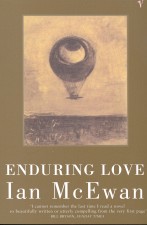
Contemporary Reads: Enduring Love

This 1997 novel by Ian McEwan has been remarked as having one of the most beautifully written opening chapters in contemporary literature. Enduring Love opens with a balloning tragic accident in which Oxford professor John Logan dies.

One of the men who tried to save him is science journalist Joe who had been out on a picnic with his partner Clarissa. Later that night at their London flat Joe receives a telephone call from Jed Parry who tells him that he loves him before Joes hangs up.

Soon, it will become apparent that Jed suffers from de Clérembault syndrome or erotomania. Jed starts to stalk Joe and sends him several letters. At first, Joe keeps all this to himself for a couple of days until he decides to confide in Clarissa. Clarissa dismisses Jed as a harmless crank. However, as Joe does some research into de Clémbrault he becomes very worried about his own safety as he learns that people who suffer that condition may appear harmless at the start they always reach a point when they become violent and dangerous. Joe's preocupation is construed by Clarissa as obsession and, as a result, their relationship suffers and she eventually moves into another bedroom.

Joe travels up to Oxford to visit John Logan's widow, Jean. She suspects her husband was having an affair as she found the contents of a picnic in his car. She makes Joe promise that he will talk to the other witnesses to try to find out is there was a woman with John although he himself does not remember seeing her.

Back in London, Joe tries to talk to the police who also dismiss the case as Jed has not at anytime made any threats. Finally, Jed hires someone to kill Joe at a restaurant where he is with Clarissa and her family. Even after this incident the police fails to act appropriately.

Joe is buying a gun for his own protection when he receives a telephone call from Jed who is holding Clarissa hostage at the flat. When Joes gets to the flat he shoots Jed and calls the police.

In the final chapter we learn that John Logan was not having an affair. He had simply given a lift to another professor and his young student lover who were to afraid to come forward as witnesses as they did not want their relationship to be made public.

Enduring Love is a compelling novel. The story is gripping the style - first person narration - draws you in from the first line. This is a joy to read.

Other books I have read by this author: Saturday, Atonement.

Tuesday, November 21, 2006

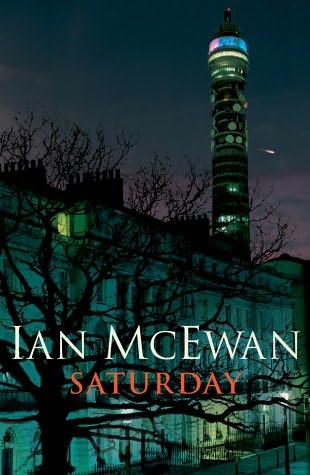
Contemporary Reads: Saturday

Ian MacEwan's latest novel Saturday takes place on February 15, 2003. Much like James Joyce's Leopold Bloom in Ulysses or Virgina Woolf's Mrs Dalloway, we follow Henry Perowne's train of thought and actions for a single day.
Unable to sleep neurosurgeon Perowne gets out of bed in the wee hours of Saturday morning. When he sees a plane in flames coming down on Heathrow airport, he fears the worse - a terrorist attack. However, he finds out this is not the case as he catches glimpes of the TV news throughout the day.
On his way to a squash game, he is involved in a minor car accident with three men coming out of a famous strip club. Attacked by their ringleader, Baxter, Perowne suspects this shady character is affected by some rare neurological desease and gives him an impromptu diagnosis and mentions a possible experimental cure for it. This unsettles Baxter, who we learn is bound to mood wings due to his condition, and Perowne manages to flee the scene. He makes his way to the gym through the masses of anti Iraq was protesters in Central London.
After been beaten up on the squash game he goes to visit her demented mother in the home she lives in. He goes home and then out again to his son's Theo's blues band rehearsal in Notting Hill.
When he gets home, his daughter, Daisy - an about-to-be-published poet who lives in Paris - arrives home after many months absence. Soon, the reast of the family: Perowne's father-in-law, the celebrate poet John Grammaticus; his wife Rosalind, the talented lawyer; and his son Theo back from his rehearsal. Only that holding a knife to Rosalind, Baxter, forces his way into the house accompanied by one of his friends, Nigel. He has come to take revenge for his humiliation that morning.
In a scene of high tension, Baxter and his ally keep the whole family hostage in their living room. Baxter makes Daisy take off all her clothes which reveals her pregnancy unbeknown to the family until then. When Baxter discovers that she is a poet by seeing the proof of her books, he makes her read out loud one of her poems. However, she justs recites an old poem her gradfather taught her in her childhood. Baxter is moved by the poem and after a few reprises asks Daisy to get dressed and tells Perowne that he wants to learn more about the cure for his illness. When Baxter and Perowne makes it upstairs to find the information about the cure the doctor bluffed about, Nigel flees the scene leaving the rest of the family alone. Theo runs upstairs and him and Perowne managed to overpower Baxter and throw him down the stairs. This the end of the nightmare.
Later on that evening, Perowne is called to hospital to operate on Baxter. The novel ends early on Sunday morning with Perowne falling asleep in bed with Rosalind.
Like it's predecessor Atonement, this novel is one of great substance which is also immensely readable.
Other books I have read by this author: Atonement.

Tuesday, November 14, 2006

Contemporary Reads: Atonement

This 2001 novel was written by British writer Ian McEwan. Its opening setting is the Tallis family's country house in Surrey on the hottest day of the summer of 1935.
Part One describes the events of that day and how they changed the lives of the three main characters of the book: Briony, Cecilia and Robbie. Briony is the youngest of the Tallis' children. A 13 year old with a fantastic imagination who fancies herself as a writer. Cecilia is her older sister who has come back from Cambridge with a third in English. Robbie is the son of their charlady who, being quite intelligent has had his Grammar school and Cambridge education paid for by Mr Tallis. In fact, he has also just returned from Cambridge although, unlike Cecilia, with a first.
Robbie and Cecilia had somehow fallen for each other. Robbie writes two love notes to her, one of them being quite graphic: "In my dreams I kiss your cunt, your sweet wet cunt." He gives this note to Briony and asks her to pass it on to Cecilia. Briony, who is upset because the play she had written for that evening had to be cancelled due to her cousins' inability to perform read the note. Shocked, from that moment on she will think of Robbie as a maniac who has to be stopped. This is only confirmed to her when she sees Robbie and Cecilia fucking in the library that evening and wrongly assumes that he was raping her sister. She will confide on her 15 year old cousin Lola.
Later on in the evening Lola's brothers, twins Jackson and Pierrot, go missing. Search parties made up by all the dinner guests, including Cecilia and Briony's brother Leon and his best friend Marshall and Lola, are sent out into the dark summer English night. Lola is raped that night outside while the search is still going on. She is found by Briony who, although she did not see the attacker clearly, falsely accuses Robbie of the violation. As a result Robbie is arrested the following morning when he shows up in the garden having found and brought back the missing twins.
Part Two is where we discover that Robbie ended up in gaol. He and Cecilia stayed in touch all those years and were reunited briefly after his release. She has become a nurse and he has been enlisted to go to war in France. On this part we follow Robbie's war experiences.
Part Three focuses on Briony. She has now become a nurse like her sister. She attends her cousin's Lola's wedding with her true raper, Marshall. Thus, we discover that is not just Briony who lied and send an innocent man to gaol but also Lola and Marshall who are now getting wed. After the ceremony, Briony visits her sister and tells her that she will confess to the police and her family about her terrible lie. Robbie is present also at that time. But why did she lie? This is not very clear but we do now know it was not out of jealousy.
In the final part of the novel, London, 1999, we found out that Briony has written what we have been reading so far. Her novel (and McEwan's), that echoes Navokov nd Virginia Woolf, is part of an act of atonement that will be completed once it is published after the death of everyone involved in the story. Everything in the novel is truth except for its ending: both Cecilia and Robbie died in 1940 and, therefore, were never reunited after the war.